Mevlevi Order & Whirling Dervishes: What the Sema Means
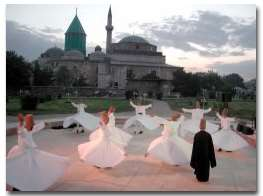
The Mevlevi tradition developed after Rumi’s death and became famous for a disciplined ceremonial form of remembrance known as sema.
How the Mevlevi tradition developed
The institutional Mevlevi order took shape after Rumi’s death, especially around his family and later followers. Mevlevi lodges became centers for poetry, music, etiquette and education.
The Mevlevi tradition took recognizable institutional form after Rumi’s death, especially through the work of his descendants and successors. Sema should therefore be studied both as a practice associated with Rumi’s circle and as a ritual that was organized and codified over time. The familiar choreography, musical ensemble, garments and sequence of salams belong to a historical tradition of development; treating every later detail as something fixed personally by Rumi collapses several centuries into one moment.
What is sema?
Sema is a ceremonial whole involving music, movement, recitation, measured walking and turning. Treating it only as a dance misses its ritual setting.
The reed flute has two related but distinct histories in Rumi studies. In the opening of the Masnavi, the speaking reed becomes an image of separation, longing and the difficulty of hearing meaning; in later Mevlevi practice, the ney also occupies a concrete musical role within the sema ensemble. The same distinction applies to clothing and instruments: symbolic explanations are important, but they should be separated from claims about when particular ritual forms or interpretations became standardized.
Why do dervishes whirl?
The controlled turning is one element in a larger devotional discipline. Symbolic explanations vary in popular accounts, so historical context matters.
Rumi’s world was the thirteenth-century Persianate environment linking Central Asia, Iran, Syria and Anatolia. Konya was a Seljuk capital with courts, madrasas, mosques, craftsmen and Sufi circles, while Mongol expansion reshaped political and intellectual life across the region. Reading Rumi in that setting helps explain why Qur’anic learning, Persian literary culture, preaching, teaching and mystical practice coexist so closely in his works.
Further context
For historical work, sources should be ranked rather than blended together. Rumi’s own writings, letters and early textual witnesses answer different questions from later hagiographies such as Aflaki’s narratives. Later sources are indispensable for the history of Mevlevi memory, but their distance from the events matters. Good citation records the work, edition or manuscript, and passage location whenever possible, and marks uncertainty instead of converting a late report into a secure fact.
Konya & Mevlâna
The Mevlana Museum is the historic complex in Konya containing Rumi’s tomb and spaces associated with the Mevlevi lodge.
Read more →Rumi was not the institutional founder
Official Turkish cultural sources describe Rumi as the pir, or spiritual master, of the Mevlevi tradition but not its institutional founder. The organized community took clearer shape after his death through Husam al-Din and especially Sultan Walad.
Sema developed over time
The formal Mevlevi Sema should not simply be projected back into every moment of Rumi’s life. The later ceremonial order—including musical and ritual elements—was disciplined and standardized by subsequent generations.
A network of lodges
Mevlevi lodges later spread through Anatolia, the Balkans, Cyprus, parts of the Arab world and North Africa. These institutions were not only ritual spaces; they also became centers of music, calligraphy, literature and etiquette.
Sources and editorial approach
Mevlana.com aims to distinguish historical evidence from later hagiography and popular attribution. When a quotation or event cannot be securely traced, that uncertainty is stated rather than presenting a modern adaptation as Rumi’s verbatim wording.