What Is Seb-i Arus? Rumi’s 17 December Commemoration
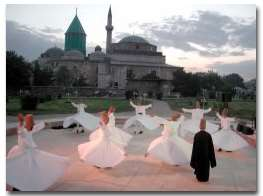
Seb-i Arus—often translated as the “wedding night”—is the name associated with the annual remembrance of Rumi’s death and his idea of reunion with the Divine.
Meaning of the name
Şeb-i Arûs is commonly translated as “wedding night.” In Mevlevi memory it expresses an interpretation of death as reunion rather than simple separation.
The Mevlevi tradition took recognizable institutional form after Rumi’s death, especially through the work of his descendants and successors. Sema should therefore be studied both as a practice associated with Rumi’s circle and as a ritual that was organized and codified over time. The familiar choreography, musical ensemble, garments and sequence of salams belong to a historical tradition of development; treating every later detail as something fixed personally by Rumi collapses several centuries into one moment.
Why 17 December?
Rumi died in Konya on 17 December 1273, so the date anchors the annual commemoration.
The broad outline of Rumi’s mature life is better established than many colorful details in later biographies. His family was in Konya by about 1229; the meeting with Shams of Tabriz in 1244 was a decisive turning point; Salah al-Din Zarkub and then Husam al-Din Chelebi became important companions; Rumi died in Konya in 1273. Earlier stages of the family’s westward journey and dramatic episodes reported in later hagiography require more caution.
Visiting Konya
December programs may include sema ceremonies, lectures and cultural events. Schedules and tickets change, so visitors should verify current details with official institutions.
Konya is not merely a backdrop to Rumi’s biography. As a Seljuk capital it connected courtly, scholarly, commercial and devotional communities, and Rumi’s household operated within that urban network. The site associated with his burial later became the center of a Mevlevi lodge and, after the closure of dervish lodges in the Republic, was preserved as a museum. Architecture, tomb space, manuscripts and ritual objects therefore document several historical periods rather than a single frozen thirteenth-century setting.
Further context
For historical work, sources should be ranked rather than blended together. Rumi’s own writings, letters and early textual witnesses answer different questions from later hagiographies such as Aflaki’s narratives. Later sources are indispensable for the history of Mevlevi memory, but their distance from the events matters. Good citation records the work, edition or manuscript, and passage location whenever possible, and marks uncertainty instead of converting a late report into a secure fact.
Konya & Mevlâna
The Mevlana Museum is the historic complex in Konya containing Rumi’s tomb and spaces associated with the Mevlevi lodge.
Read more →Additional depth
The reed flute has two related but distinct histories in Rumi studies. In the opening of the Masnavi, the speaking reed becomes an image of separation, longing and the difficulty of hearing meaning; in later Mevlevi practice, the ney also occupies a concrete musical role within the sema ensemble. The same distinction applies to clothing and instruments: symbolic explanations are important, but they should be separated from claims about when particular ritual forms or interpretations became standardized.
Rumi’s world was the thirteenth-century Persianate environment linking Central Asia, Iran, Syria and Anatolia. Konya was a Seljuk capital with courts, madrasas, mosques, craftsmen and Sufi circles, while Mongol expansion reshaped political and intellectual life across the region. Reading Rumi in that setting helps explain why Qur’anic learning, Persian literary culture, preaching, teaching and mystical practice coexist so closely in his works.
The people around Rumi should be understood through specific functions rather than as interchangeable disciples. Husam al-Din Chelebi wrote down and edited the Masnavi dictations and became Rumi’s first successor; Sultan Walad later became central to the institutional development of the Mevlevi community; Baha al-Din Walad was a preacher and scholar whose Ma‘arif preserves his own religious thought. Individual biographies are most useful when they show how these distinct roles affected texts, teaching and succession.
Rumi’s surviving corpus represents several genres and social settings. The Masnavi is an extended six-book didactic poem; the Divan contains lyric poetry associated especially with Shams; Fihi ma fihi was compiled from notes made in Rumi’s teaching circle; the Maktubat preserve letters written for practical and social purposes; the Seven Sermons reflect formal preaching. A claim drawn from one of these genres should not automatically be treated as if it came from another.